By early 2020, I’d lost the job I was good at, the marriage that anchored me, and pretty much everything else that felt familiar — all inside about two weeks, with COVID shutting down the rest of the world for good measure. I’ve told that part already.
What matters here is what I did with all the unstructured time it left me.
I was newly divorced, living in a new place in the city, isolated by COVID, detached from work, and trying to figure out what this new version of my life was supposed to be.
And I was smoking a lot of weed.
I’d wake up in the morning and smoke. Then I’d smoke during the day. Then smoke throughout the evening. I was out of control. There wasn’t an office to go to, nobody was watching very closely, and frankly, I wasn’t particularly interested in being watched.
It became part of checking out.
That’s about the time I started hanging around with a guy named Rafael.
Rafael was wild. We had become the only two humans in Houston to still live our lives despite COVID and we were hanging out on a regular basis.
He belonged to a completely different world that had suddenly opened up around me. After decades of marriage, suburbs, career, responsibility and predictability, everything had been scrambled.
So apparently I decided the logical next step in rebuilding my life was to get my own weed guy.
At first, I bought little bits of weed through Rafael. Eventually even that seemed inefficient.
One day I told him, “I need my own guy.”
Rafael said, “Okay. I’ll find you somebody.”
A few days later he called.
“You gonna be home?”
Of course I was home.
I wasn’t working.
“I’m bringing a guy over. His name’s Jamol.”
“Who’s Jamol?”
“That’s your new guy.”
Perfect.
I had arrived.
I now had my own personal weed concierge.
Jamol showed up that afternoon.
He was tall, Black, nicely dressed — polo shirt, jeans, clean white sneakers — and polite as a church usher. He had the kind of easy, upright posture that made you think somebody had once stood behind him with a hand on his shoulder blades. A gold chain, thin, nothing flashy. He moved like a guy who’d played sports and never quite lost the habit of walking on the balls of his feet.
“Yes, sir.”
“No, sir.”
We sat around, drank a couple of beers, and talked. I liked him immediately.
At some point I said, “Jamol, you’re a very polite young man. I can tell you were raised right.”
He smiled.
“But Jamol, that doesn’t really have anything to do with you. That’s your mama. So next time you see her, I want you to tell her something for me.”
He looked at me.
“Tell her that she raised a fine young man.”
He smiled.
“Tell her the guy you just sold weed to said she raised a fine young man.”
Jamol looked at me with this serious face for several seconds — then started cracking up. He got my joke.
Friendship, sealed.
For a while, the arrangement was fantastic. I’d call Jamol. Jamol would come by. We’d drink a beer, talk about life, his boy, and he’d leave me with a little weed.
This was customer service.
Then Jamol started getting lazy.
He lived on the east side of Houston, and gradually the delivery portion of my weed concierge service disappeared.
I’d call.
“Hey, Jamol.”
“Man, I can’t get over there. Can you meet me?”
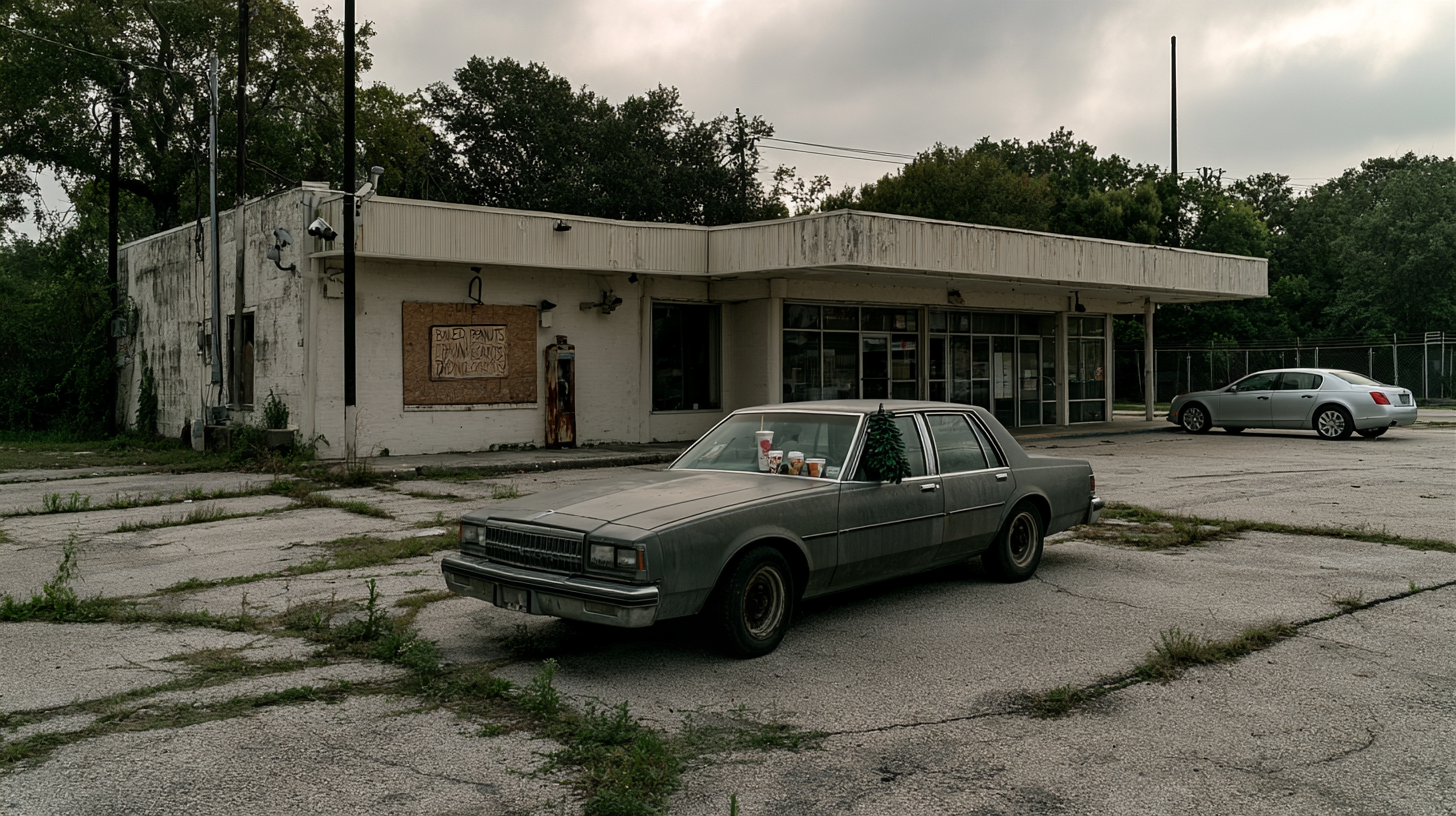
Then he’d send me a location somewhere in Galena Park or Channelview, usually a bombed-out convenience store that looked like the sort of place where even the security cameras had given up. Plywood over one window. A hand-lettered sign advertising boiled peanuts and phone cards. The parking lot cracked into its own little continents, weeds pushing up through the seams.
So I’d drive my Audi out there.
That alone was funny.
I’d pull into some beat-up Stop-N-Go-looking place in a luxury sedan, feeling every bit like a man who’d taken a wrong turn out of a car commercial. Jamol would pull up in whatever he was driving that week, and I’d climb into his passenger seat, which usually smelled like a pine tree air freshener losing a fight against fast food.
And the funny thing was, we weren’t sitting around discussing criminal enterprises.
We talked about books.
Self-improvement.
Things we were trying to do better.
Jamol had a new baby boy, and he was enormously proud of him. He’d pull out his phone and show me pictures. His whole face changed when he talked about that kid — some private, unguarded softness that had nothing to do with the transaction we were technically there for.
He had also once been a quarterback at North Shore High School, one of the powerhouse high school football programs in Texas.
Other people knew professional athletes.
My connection to fame was that my weed dealer had played quarterback at North Shore.
Eventually, though, Jamol’s laziness reached a whole new level.
One day I called him and he sent me an address.
It wasn’t a convenience store this time.
It was a trailer.
More specifically, it was one of six or eight construction-office-type trailers scattered around a gravel lot in Channelview, parked at angles that suggested the city planning department had probably not been consulted. Chain-link fence sagging on one side. A few of the trailers looked lived-in, window units dripping rust streaks down the siding. Others looked abandoned, doors hanging open on nothing. Somewhere off to one side, a big dog was chained to one of the trailers, barking at absolutely nothing in particular, the way dogs do when they’ve decided barking is simply their job now. On the other side, I heard a man and woman screaming at each other in Spanish from one of the trailers.

I pulled up in the Audi.
Even by the standards of my new life, I remember thinking:
This is a little different.
I got out and knocked on the door.
A guy cracked it open. Young, maybe early twenties, in a plain white T-shirt, looking at me the way you’d look at a Jehovah’s Witness who’d wandered somewhere he clearly shouldn’t have.
“Yeah?”
“Hey, man. I’m Larry. Jamol told me to meet him here.”
The door closed.
That was encouraging.
A few seconds later it opened again.
“Come in.”
So naturally, I went in.
The inside was nothing like the outside promised. Cheap paneling on the walls, the fake-wood kind that comes in four-by-eight sheets. A window unit rattling in the back, working overtime against the Houston heat and losing. The air was thick with weed smell layered over with body odor and gun powder. A folding table. A couple of mismatched office chairs that looked like they’d been salvaged from a bank that went out of business in 1994.
The first thing I saw was marijuana — not a bag, not a few bags, but a pile stacked about two feet high and two feet across, sitting in the middle of the trailer like furniture. Somebody had clearly given up on containers.
Off to one side, a guy was running bills through a money counter, strapping the stacks together with rubber bands as they came out, not even looking up. He had the flat, repetitive focus of somebody doing data entry, which, in a sense, he was.
There were three other guys in spirited conversation, all in Spanish. Tattooed from head-to-toe with neck and face tattoos that immediately tell a person, “Don’t even think about making eye contact with me, Gringo mother fucker.”
There were guns in easy reach. One of them looked like an assault rifle, propped against the wall the way you’d lean a golf umbrella by the door.
In the corner, behind a desk, sat a guy with his leg in a brace — early thirties, friendly enough, heavyset, wearing a Rockets jersey a size too big — who was clearly running the place. He had the calm, unhurried manner of a man who owned the room and didn’t feel the need to prove it.

This was not some guy selling a little weed out of his apartment.
This was the kind of place Channel 13 would lead with at six o’clock:
“After months of surveillance, authorities today dismantled what investigators describe as a major drug distribution operation, seizing drugs, guns and large amounts of cash.”
Apparently Channel 13 needed months of surveillance.
I just knocked on the fucking door.
For a second, standing there, it registered exactly what I was looking at — and that nobody outside that trailer had any idea where I was. It was a strange, cold little thought, gone almost as fast as it arrived.
And because I apparently have no internal setting between “stranger” and “new best friend,” I immediately started talking to everybody.
“Hey, boys. How’s it going?”
They looked at me.
I looked around.
“Wow. You guys have some stuff in here. You know, I saw a special at Target for some large plastic storage bins. You guys should check it out.”
I pointed at the guy behind the desk.
“Looks like you’ve got a bad wheel there, fella.”
He stared at me for a second, probably trying to determine whether I was a cop, an idiot, or somebody’s confused father.
Eventually he told me what happened. I don’t remember the details. A fight, maybe. Somebody had broken his leg. Something along those lines.
So there I was: cheerful older white guy, luxury car parked outside, standing in the middle of an actual drug operation making small talk about orthopedic injuries with the guy who appeared to be running it.
Then there was a knock at the door.
The door cracked open.
Money went one direction.
Drugs went the other.
Door closed.
A few minutes later, another knock.
Same thing.
Then another.
Different faces each time, different builds, different clothes, but the same shape of transaction, over and over, like watching the same three seconds of a movie on a loop.
At some point, it occurred to me that perhaps sitting inside an active cartel drug house for an extended period of time was not one of my better ideas.
This wasn’t Jamol dropping off a little weed at my place.
This was inventory.
This was distribution.
This was the warehouse.
This was guns — assault rifles.
This was cartel.
This was a fucking Quentin Tarantino movie just when something really bad is about to happen.

And then I realized something else.
I was waiting for Jamol to arrive at the place where Jamol bought the weed that Jamol was going to sell to me for forty dollars. I was thinking about how this would go down when I was explaining to the other inmates why I was doing forty years. This couldn’t be happening. I felt scared and small at the same time.
Let me make sure I have this straight.
I had driven all the way across Houston, walked directly into a cartel operation — with no effort whatsoever, and was now waiting for Jamol to show up, buy twenty dollars of weed from the guy standing five feet away from me, and then turn around, not taking a step, and sell it to me for forty dollars. In my professional life of risk assessment on multi-million dollar projects, this was a slam-dunk on a no-go decision. I was thinking that I needed to change my occupation to undercover. Transferring that into my sales world, I would be in President’s Club every year.
I remember thinking:
This son of a bitch is lazy.
Forget the guns.
Forget the drugs.
Forget the fact that I was sitting in a place that could reasonably appear on the evening news.
Forget the forty years of hard time if the bust happened in the next few minutes.
Now I was pissed off about the middleman’s markup.
Why am I waiting for Jamol?
The wholesaler is standing right here.
Apparently I had finally discovered my limit.
Not danger.
Not good judgment.
Inefficient distribution.
That was when I decided Jamol and I needed to have a conversation about customer service.
Eventually, Jamol got there and did exactly what I’d pictured: he bought the weed from the guy, turned around without taking a step, and sold it to me. I was more humiliated by how foolish I looked than scared of the situation.
I probably should have been scared, but I wasn’t. I was friendly. They loosened up. We joked around and drank a couple of beers. By the time I left, the guy with the leg brace was laughing so hard he had to hold on to the desk.
I never went back.
But I walked away with several new friends and a hell of a story — one that had no business anywhere near Cinco Ranch, my old Wonder Bread and Velveeta suburb, where the HOA wrote letters about the wrong shade of mulch, every lifted truck had never seen mud, every pool sat unswum, and a coyote sighting on the neighborhood Facebook group counted as a national emergency. I pictured trying to wedge my story in between Brad’s update on Emilie’s college applications and Nancy’s new $12,000 table from Luis Shanks, and realized there was no graceful way to follow “assault rifle” with “anyway, more queso?” Out there, my story wouldn’t have made me interesting. It would have gotten me quietly uninvited.
Jamol and I remained friends after that.
We even talked about throwing parties together. He was a rapper and made videos, and I kept telling him I wanted to be in one.
I had no particular qualifications for appearing in a rap video other than being an older white guy. Maybe I could play a cop or an angry old white neighbor. Who knew, but I thought it would be funny.
Unfortunately, my rap career never materialized.
Eventually Jamol and I lost touch, although we stayed connected on Instagram for a while. Every so often I’d see another picture of his son.
He was always proud of that boy.
I’ve heard from him more recently, and it turns out I wasn’t wrong about him — he’s doing fantastic, working in refinery construction, leading a team, taking on massive projects. Those qualities were there the whole time, even when the job was walking a little weed across town.
When I look back on that period now, Jamol is one of those characters who represents something bigger than himself.
I had spent decades living a structured life.
Marriage.
Career.
Suburbs.
Responsibilities.
Then almost overnight, the structure disappeared.
And for a while, so did I.
I stopped working without quitting. I moved into the city. I smoked weed instead of working. I started hanging around with people I never would have met before. I wandered into places where I clearly didn’t belong and behaved as though I’d been invited to a neighborhood barbecue.
It was reckless.
It was ridiculous.
And, looking back, it makes a certain kind of sense.
I wasn’t simply trying to have fun. I think I was trying to disappear from the life that had just disappeared on me.
For a while, checking out was easier than figuring out what came next.
But there’s something else I remember about that time.
For all the stupidity of it, I was meeting people I never would have met in my old life. Jamol wasn’t a caricature. He was a young father who adored his son. He read books. He thought about improving himself. He had once quarterbacked one of the best high school football programs in Texas.
He also happened to sell me weed.
Life had become strange enough that all of those things could be true at the same time.
Maybe that’s why I still remember him.
Or maybe I remember him because somewhere in the middle of divorce, COVID, anger, apathy, weed, and a completely unfamiliar version of myself, I achieved a milestone I never knew I needed.
I got my own guy.
His name was Jamol.
 larryhudsonexperiencecollection.com