The first time I walked into a cartel stash house, I was there to buy forty dollars’ worth of weed.
I ended up giving the boss business advice.
That probably tells you something about me.
Somewhere along the way, I lost the part of my brain that’s supposed to get scared.
In Cape Town, four guys jumped me and tried to kidnap me. I fought them off before they could get me in the car, but not before one of them swung a hockey stick at my head.
They say the brain can fire off a billion signals in less than a second. Out of all of them, the last thought I had before that stick connected was:
What the hell are they doing with a hockey stick in Cape Town?
Then it split my head open.
I didn’t get scared. I got mad. Then I went to work the next morning and closed a deal, like that was a normal thing to do.
It’s not a gift. It’s training.
Call it street training. For years, my job was walking into rooms in places like Russia, Kuwait, and South Africa, where I didn’t speak the language or know the customs, and building close relationships fast. You don’t learn that in a sales seminar. You learn it by getting it wrong a few times in front of people who aren’t going to give you a second chance.
It taught me three rules.
One. Own it. Wherever you are, own it, and don’t show fear.
Two. Respect the people, and respect the protocol. Don’t force your reality into theirs.
Three. Find something to laugh about. Laughter gets you past the language, the customs, and the distrust faster than anything else.
By early 2020, I’d lost the job I was good at, the marriage that anchored me, and pretty much everything else that felt familiar, all inside about two weeks. COVID shut down the rest of the world for good measure.
What matters here is what I did with all the empty time it left me.
I smoked a lot of weed.
I’d wake up and smoke. I’d smoke during the day. I’d smoke through the evening. There was no office to go to, nobody was watching very closely, and frankly, I wasn’t interested in being watched.
It became part of checking out.
That’s about when I started hanging around with Rafael. Rafael was wild. As far as I could tell, we were the only two humans in Houston still living our lives despite COVID. He belonged to a completely different world, one that had suddenly opened up around me after decades of marriage, suburbs, career, and predictability. You’ll meet Rafael and his crowd in another chapter, “The Jungle.”
So apparently I decided the logical next step in rebuilding my life was to get my own weed guy.
At first I bought little bits through Rafael. Eventually even that seemed inefficient.
“I need my own guy,” I told him.
“Okay,” Rafael said. “I’ll find you somebody.”
A few days later he called.
“You gonna be home?”
Of course I was home. I wasn’t working.
“I’m bringing a guy over. His name’s Jamol.”
“Who’s Jamol?”
“That’s your new guy.”
Perfect.
I had arrived.
I now had my own personal weed concierge.
Jamol showed up that afternoon, and he filled the doorway.
He was tall, long through the arms and shoulders, lean and hard in a way that didn’t come from a gym. He was built like a guy who could throw a football sixty yards flat-footed. Black polo, jeans, clean white sneakers, a gold chain resting on his chest. Nothing about him was loud. Everything about him was noticed.
He moved like an athlete who’d never lost the habit of being ready. Upright, like somebody had once stood behind him with a hand on his shoulder blades and never really let go.
He had the kind of cool you can’t practice. It’s either in you or it isn’t.
Then he opened his mouth.
“Yes, sir.”
“No, sir.”
This man looked like he ran half of east Houston, and he had the manners of a deacon. That was the first thing I learned about Jamol. The most dangerous-looking guy in the room was also the most respectful.
We drank a couple of beers and talked. I liked him immediately.
At some point I said, “Jamol, you’re a very polite young man. I can tell you were raised right. But that doesn’t really have anything to do with you. That’s your mama. So next time you see her, I want you to tell her something for me.”
He looked at me.
“Tell her the guy you just sold weed to said she raised a fine young man.”
Jamol held a serious face for several seconds, then cracked up.
Friendship, sealed.
For a while, the arrangement was fantastic. Most nights, Jamol came to my house. I’d cook. He’d eat. Usually he brought his main, Jasmine. She was stunning. Tall, slim, the kind of beautiful that makes a room go quiet. She was feisty and cool, too, and we liked each other right away.
Over those dinners, I started to learn who my weed guy actually was.
He’d been the quarterback at North Shore, one of the powerhouse programs in Texas. The guy the whole stadium watched on Friday nights. Good enough that Texas A&M came calling.
He went. He worked out with the team. He was right there.
Then his mother needed him.
So he walked away. From A&M, from football, from all of it. He came home and took care of her.
He didn’t tell it like a tragedy. He didn’t tell it like he was a hero, either. He told it like a fact. His mother needed him, so he went home. Simple as that.
That’s the thing about the real ones. They never tell you the story that makes them look good. You have to find out on your own.
I never met his mother, but I felt like I knew her. She was strict. You could tell. She’s the one who put the “yes, sir” and “no, sir” in him. The posture. The manners. The discipline. She planted the idea that he was going to be somebody.
Which made my little joke that first afternoon land a lot differently in hindsight.
I’d told him to tell his mama she raised a fine young man.
I was right. I just didn’t know yet how right.
He had a new baby boy, and he couldn’t stop showing me pictures. This big, powerful man, and his whole face went soft the second he talked about that kid.
That’s why he sold weed. Not for the chains. Not for the lifestyle. He had a son to feed, and he was going to feed him. It paid the bills while he figured out the rest.
And he read. Real books. The Road Less Traveled. The 48 Laws of Power, so many times the cover was coming off. Most of the time, he’d gone deeper into them than I had. More than once, he changed my mind.
He was a rapper, too. A good one. His videos had real production quality. I kept telling him I wanted to be in one, maybe as a cop or an angry old white neighbor. He never took me up on it.
And he never once bragged about any of it.
He didn’t talk much. He didn’t need to. People came to Jamol.
He knew everybody. The guys in the convenience store lots. The guys in the trailers. The guys behind the guys. Doors opened when his name was said. I’d find that out firsthand in a Channelview trailer, where “Jamol told me to meet him here” was the only password I needed.
One night I asked him who his baby mama was. I used those exact words. I thought I sounded cool. I’m sure I sounded like exactly what I was.
It was Jasmine.

“Are you guys married?”
“No,” he said. “I do things differently. We’re different than you folks.”
I asked him what he meant by that.
He explained it like a baseball manager. He had a starting rotation. Three or four women. Maybe five. I lost count. Jasmine was the ace. The number one spot was hers. He protected her. He adored her. And she kept that spot as long as she didn’t mess up.
If she did, she went into what he called punishment.
Depending on the infraction, she lost rank. A small one, maybe she dropped to number two for a while. A serious one, she could fall to three or four. Everybody else moved up accordingly. That was the pecking order, and it kept everyone in line. They were all jockeying for the top spot.
I didn’t know what was more fascinating. That the women went along with it, or that he pulled it off.
I told him flat out that shit would never fly with white women. We laughed until our sides hurt.
Looking back, I’m not sure the women were laughing quite as hard.
Then Jamol got too busy. Or just lazy.
He lived on the east side of Houston, and gradually the delivery portion of my concierge service disappeared.
“Man, I can’t get over there. Can you meet me?”
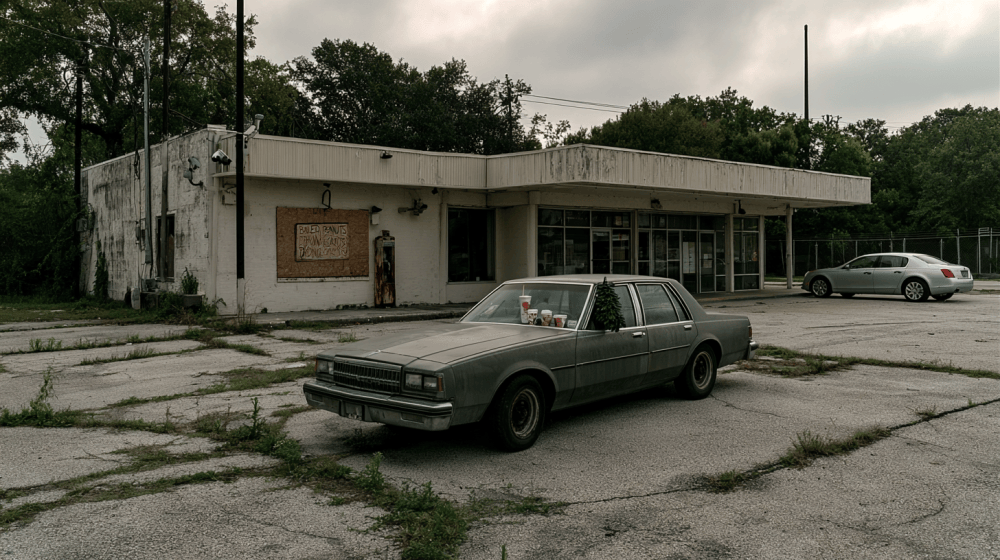
Then he’d send a location in Galena Park or Channelview. It was usually a bombed-out convenience store where even the security cameras had given up. There was plywood over one window and a hand-lettered sign for boiled peanuts and phone cards. The parking lot had cracked into its own little continents.
So I’d drive out there, a suburban guy in a golf shirt, looking like I’d taken a very wrong exit.
Then Jamol would roll up in his Escalade.
Black. Tricked out. Detailed so meticulously you could check your teeth in the paint. In a parking lot full of cracked pavement and plywood windows, it looked like it had been dropped in from another world. So did he.
I’d climb into his passenger seat. The leather was spotless. The dash was spotless. Not a crumb, not a receipt, not a speck of dust. The man kept that truck the way his mama probably kept her living room.
And we still weren’t discussing criminal enterprises. We were discussing M. Scott Peck.
We’d both read The Road Less Traveled, and we could not agree on it.
“Love’s not a feeling,” I told him one afternoon. “That’s Peck’s whole point. The feeling is falling in love. That wears off. Love is what you decide to do after.”
“Nah,” Jamol said. “If you gotta decide it, it ain’t love. That’s a job.”
“Marriage is a job.”
He looked at me. “And how’d that work out for you?”
Fair.
Then we got to laziness. Peck says laziness is the root of most of our problems. That we avoid the hard thing because it’s hard, and everything else goes wrong from there.
Jamol wasn’t having it. “People ain’t lazy. People are tired. That’s different.”
I pointed out that I had just driven across Houston to a boarded-up convenience store because he didn’t feel like driving to my house.
He thought about that for a second.
“That’s efficiency,” he said.
Neither of us had a degree in any of it. That never slowed us down.
Then Jamol’s laziness reached a whole new level.
One day he sent me an address. It wasn’t a convenience store.
It was a trailer.
More specifically, it was one of six or eight construction-office trailers scattered around a gravel lot in Channelview. They were parked at angles suggesting the city planning department had not been consulted. Chain-link fence sagged on one side, and window units dripped rust streaks down the siding. A big dog chained to one trailer barked at absolutely nothing, the way dogs do once they’ve decided barking is simply their job. From another trailer, a man and a woman were screaming at each other in Spanish.
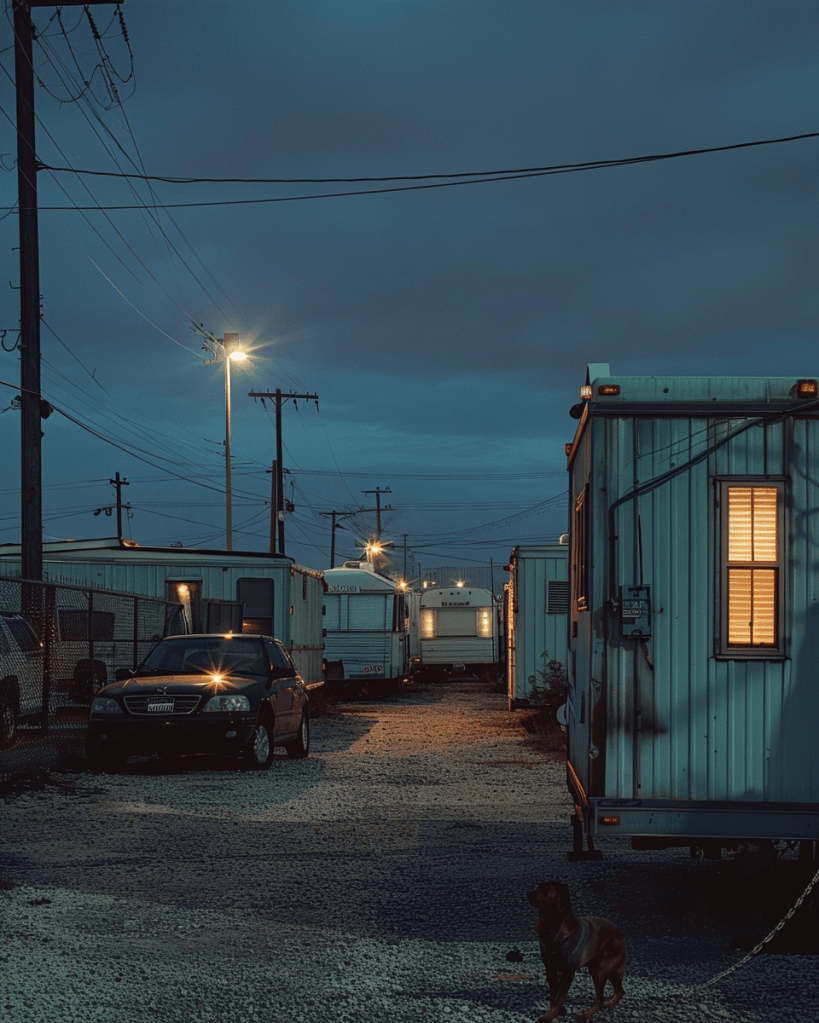
Even by the standards of my new life, I remember thinking: This is a little different.
I knocked.
A young guy in a plain white T-shirt cracked the door. He looked at me the way you’d look at a Jehovah’s Witness who’d wandered somewhere he clearly shouldn’t have.
“Yeah?”
“Hey, man. I’m Larry. Jamol told me to meet him here.”
The door closed.
That was encouraging.
A few seconds later it opened again.
“Come in.”
So naturally, I went in.
Cheap fake-wood paneling covered the walls. A window unit rattled in the back, losing its fight with the Houston heat. The air was thick with weed, body odor, and gun oil.
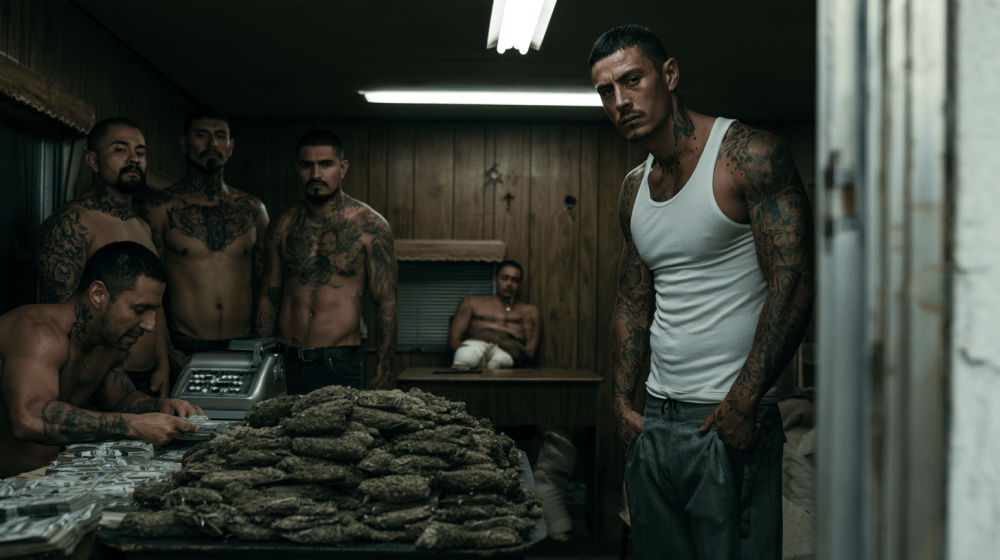
The first thing I saw was marijuana. It wasn’t a bag, or a few bags. It was a pile two feet high and two feet across, sitting in the middle of the trailer like furniture. Somebody had clearly given up on containers.
Off to one side, a guy ran bills through a money counter and rubber-banded the stacks without looking up. He had the flat, repetitive focus of somebody doing data entry, which, in a sense, he was.
Three other guys were in spirited conversation in Spanish. They were tattooed head to toe, with the kind of neck and face ink that immediately tells a person, “Don’t even think about making eye contact with me, gringo motherfucker.”
Then I saw the guns.
Nobody was hiding them. That was the part that got me. A black pistol sat on the table next to the money counter, right there with the rubber bands, like a stapler. The kid who’d opened the door turned around, and there was another one jammed in the back of his waistband. I hadn’t even noticed it when he was looking me in the face.
And leaning against the paneling by the back wall, with a long curved magazine already in it, was an AK-47.
I knew exactly what it was. My son has one. But seeing one in my son’s gun safe is one thing. Seeing one propped against a wall in a Channelview trailer, three feet from a pile of weed and a stack of cash, is something else entirely. It was the kind of gun that doesn’t exist for hunting or target practice. It exists to end arguments.
Nobody was holding it.
Nobody needed to.
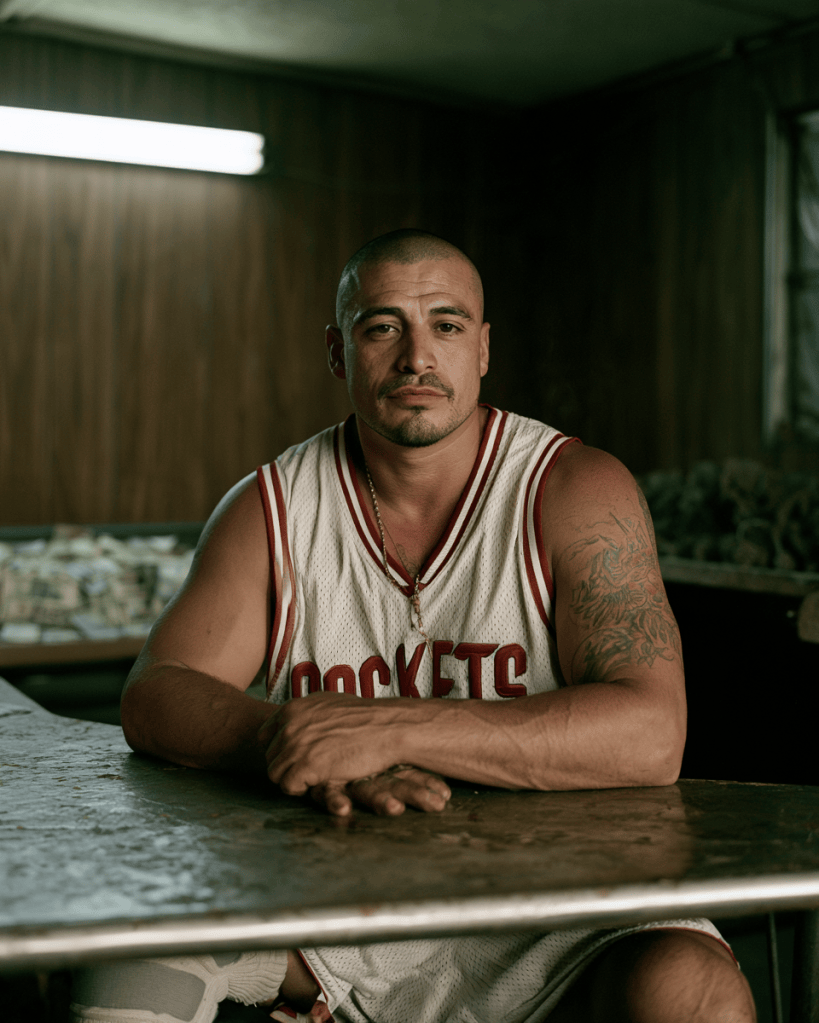
Behind a desk in the corner sat the man clearly running the place. He was early thirties, heavyset, wearing a Rockets jersey a size too big, with his leg in a brace. He had the calm, unhurried manner of a man who owned the room and didn’t feel the need to prove it. He didn’t have to. The AK was proving it for him.
This was not some guy selling weed out of his apartment.
This was the kind of place Channel 13 leads with at six o’clock: “After months of surveillance, authorities today dismantled a major drug distribution operation, seizing drugs, guns, and large amounts of cash.”
Channel 13 needed months of surveillance.
I just knocked on the fucking door.
Then the door shut behind me, and I heard the lock.
For a second, everything went very quiet in my head. Nobody knew I was here. Not my kids. Not Rafael. Not a single person outside that trailer. If I didn’t walk back out of that gravel lot in Channelview, there was no one who would even know where to start looking.
I noticed the AK again. I noticed the pistol on the table was closer to the boss’s hand than the money was. I noticed that nobody was smiling. I noticed that I was the only person in the room who didn’t know the rules.
It was a cold little thought, and it sat right in the middle of my chest.
For about one second, the training slipped.
Then it kicked back in.
Rule one. Own it. Don’t show fear.
And because I have no internal setting between “stranger” and “new best friend,” I did the only thing I know how to do.
“Hey, boys. How’s it going?”
Nothing.
Rule three. Find something to laugh about.
“Wow. You guys have some stuff in here. You know, Target’s got a special on those big plastic storage bins. You guys should check it out.”
They looked at me. Then they looked at each other. Is this gringo for real?
The boss looked at the pile. Then back at me.
For one second, I swear he was considering it.
I pointed at his leg.
“Looks like you’ve got a bad wheel there, fella.”
He stared at me, probably trying to decide whether I was a cop, an idiot, or somebody’s confused father. Then he told me about it. A fight, maybe. Somebody had broken his leg.
So there I was: a cheerful older white guy from the suburbs, making small talk about orthopedic injuries with the man running an actual drug operation.
There was a knock at the door.
Every head in the room turned. A hand drifted toward the pistol on the table and stayed there.
The door cracked open. Money went one direction. Drugs went the other. The door closed. The hand came back.
A few minutes later, another knock.
Same thing.
Then another.
The faces were different each time, but it was the same transaction, over and over, like watching three seconds of a movie on a loop.
This wasn’t Jamol dropping off a little weed at my place.
This was inventory.
This was distribution.
This was the warehouse.
This was a Quentin Tarantino movie right before something really bad happens.
And then it hit me.
I was waiting for Jamol to show up, buy twenty dollars of weed from the guy five feet away from me, then turn around, without taking a single step, and sell it to me for forty.
I’d spent my career doing risk assessment on multimillion-dollar projects. This was a slam-dunk no-go. I’d driven across Houston, walked straight into a cartel operation with zero effort, and put myself one police raid away from explaining to my cellmates that I was doing forty years for a forty-dollar bag.
And my only thought was:
This son of a bitch is lazy.
Excuse me. Efficient.
Forget the guns.
Forget the drugs.
Forget the evening news.
Now I was pissed off about the middleman’s markup.
Why am I waiting for Jamol? The wholesaler is standing right here.
I had finally discovered my limit.
Not danger.
Not good judgment.
Inefficient distribution.
But rule two. Respect the protocol. Don’t force your reality into theirs.
You don’t cut out another man’s middleman in his own house. Jamol brought me here. Jamol would handle it. So I waited.
Eventually Jamol walked in and did exactly what I’d pictured. He bought the weed, turned around without taking a step, and sold it to me.
And the other half of rule two: respect the people.
Those guys didn’t owe me a thing. I was a stranger in their house. So I treated them the way I’d treated every customer in every country I’d ever sat down in. I was friendly. I was respectful. They loosened up. We joked around and drank a couple of beers. By the time I left, the guy in the leg brace was laughing so hard he had to hold on to the desk.
Three for three.
I never went back.
But I walked away with several new friends and a hell of a story, one with no business anywhere near Cinco Ranch, my old Wonder Bread and Velveeta suburb, where a coyote sighting on the neighborhood Facebook group counted as a national emergency. There was no graceful way to follow “AK-47” with “anyway, more queso?”
Jamol and I stayed friends. The last time I really saw him was at a house party Rafael dragged me to in North Houston. That party deserves its own story. But at one point, I got everybody’s attention and made a toast to Jamol. It wasn’t really a toast. It was more of a speech. I told them he was a leader. I told them he would be successful at whatever he decided to do. Then I asked if anybody knew his secret.
People guessed. Hustle. Luck. Somebody said his looks.
“He’s a reader,” I said. “Leaders are readers.”
Jamol just stood there. He didn’t say a word. He didn’t have to. You could see it on his face. He was proud.
After that we drifted, the way people do. Every so often on Instagram I’d see another picture of his son.
Then I heard from him recently. That toast was right. He’s working in refinery construction now, leading a team, taking on massive projects.
His mama planted that seed a long time ago. Selling weed was just how he fed his boy while it grew.
I’d spent decades living a structured life. Marriage. Career. Suburbs. Then, almost overnight, the structure disappeared.
And for a while, so did I.
I went places I never should have been and acted like I’d been invited to a neighborhood barbecue. It was reckless. It was ridiculous. Looking back, I wasn’t just trying to have fun. I was trying to disappear from the life that had just disappeared on me.
But somewhere in the middle of all that, in a pile of divorce, COVID, anger, apathy, and weed, I met the most quietly impressive man of that whole strange stretch of my life. A quarterback who walked away from A&M for his mother. A father who went soft at the sight of his son. A reader who understood the books better than I did.
He also happened to sell me weed.
I got my own guy.
His name is Jamol.

