I went to Romania to find out if it was a real market.
We were selling sophisticated industrial safety systems. Expensive ones. I honestly didn’t know whether anybody there would want them, could afford them, or was ready for the technology we were bringing.
I flew in from Vienna on a Friday night.
Bucharest was gray.
That’s the first thing I remember. It was already dark, the streets were wet, and everyone seemed to be dressed in dark colors. Nobody looked particularly happy. There was a melancholy about the place I couldn’t quite put my finger on.
By then, I’d traveled enough that I’d gotten extremely comfortable with it. Maybe a little too comfortable. I hardly prepared anymore. I could land in a foreign country, figure out the currency, get a ride, find my hotel, and be sitting somewhere with a beer within an hour.
Romania was about to remind me I wasn’t nearly as clever as I thought I was.
I’d been traveling with euros, but Romania had its own currency, the leu. My routine was to hit an ATM at the airport and pull out enough local cash to get me through the first few days.
My card didn’t work.
Here I was, in a country I’d never visited, standing in an airport after dark, carrying money I couldn’t spend and holding a bank card that wasn’t doing me a damn bit of good.
I wondered if my phone would even work.
Fortunately, it did.
I called the Marriott, explained my situation, and asked whether they could send a car and put it on my room.
Of course, they said.
One problem solved.
What I didn’t realize was that they’d also sent me my first Romanian tour guide.
The driver was thrilled to have an American in his car. He spoke very little English, and I spoke no Romanian whatsoever, but that wasn’t going to stop him.
He was determined to introduce me to his country.
As we drove toward the city, he pointed at buildings, monuments, and landmarks, turning toward me with a big smile and announcing, in broken English, two words.
“National treasure!”
Everything was a national treasure.
We approached Romania’s version of the Arc de Triomphe. He pointed at it proudly and, through gestures and broken English, let me know it was exactly one third the size of the one in Paris.
Exactly one third.
I loved that.
Most people would apologize for having a smaller monument than the original. This guy had figured out how to make it an accomplishment.
A little farther down the road, we stopped at a traffic light.
He pointed toward a bus stop.
“National treasure!”
I looked out the window.
It was a bus stop.
I looked back at him, confused.
“National treasure!” he repeated, pointing harder.
What made this bus stop so special? Was it historic? The first bus stop in Bucharest?
Finally, after several attempts, he got it across.
Not the bus stop.
The woman standing at the bus stop.
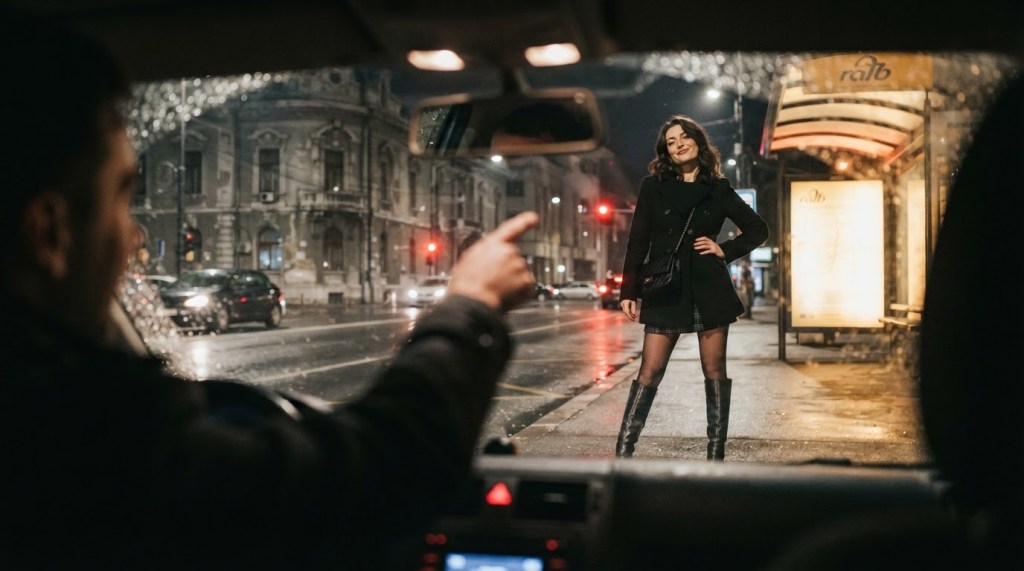
And, quite frankly, he had a point.
We both started laughing.
I was beginning to like Romania.
The girl behind the glass
The Marriott was spectacular.
Walking through the front doors was like entering another country. High ceilings, ornate wallpaper, brass lamps, couches and seating areas everywhere.
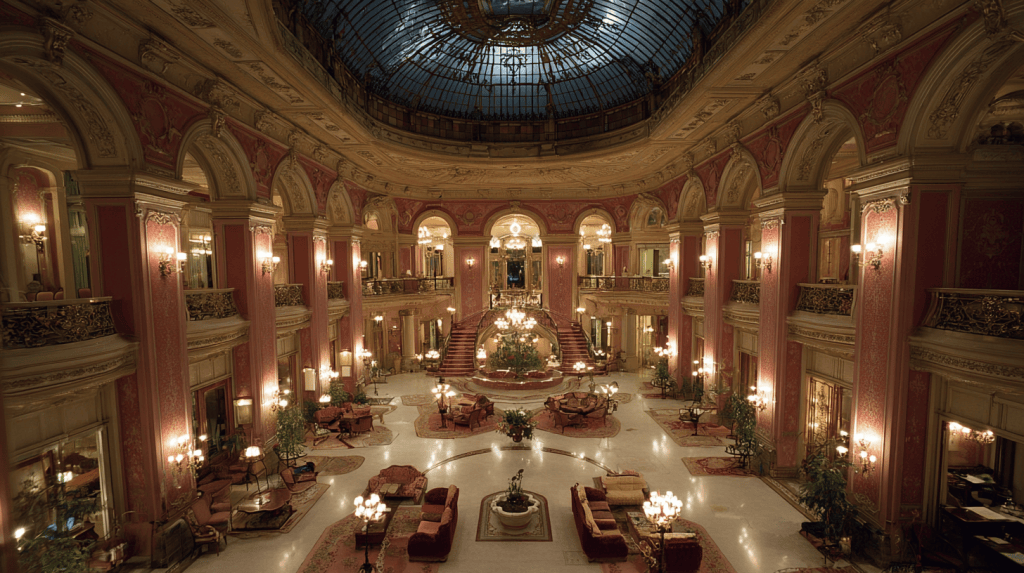
I’d stayed in Marriotts all over the world, and this staff was as well-trained as any I’d ever seen.
I checked in, tried and failed to get the hotel to advance me a little cash, and settled onto a couch in the lobby.
At least I had a room. I was going to be fine.
Then I heard a noise.
At the end of a long hallway, something was pounding on a glass door. From where I sat, I couldn’t make out what it was.
I started to get up.
The gentleman sitting across from me stopped me.
“Don’t let her in. Don’t let her in.”
“Really?”
“Please. Don’t let her in.”
Naturally, I had to go see.
As I got closer, I realized it was a young girl, barely a teenager, if that.
Her hair was badly matted. Her clothes were filthy. She was pounding on the glass with both hands.
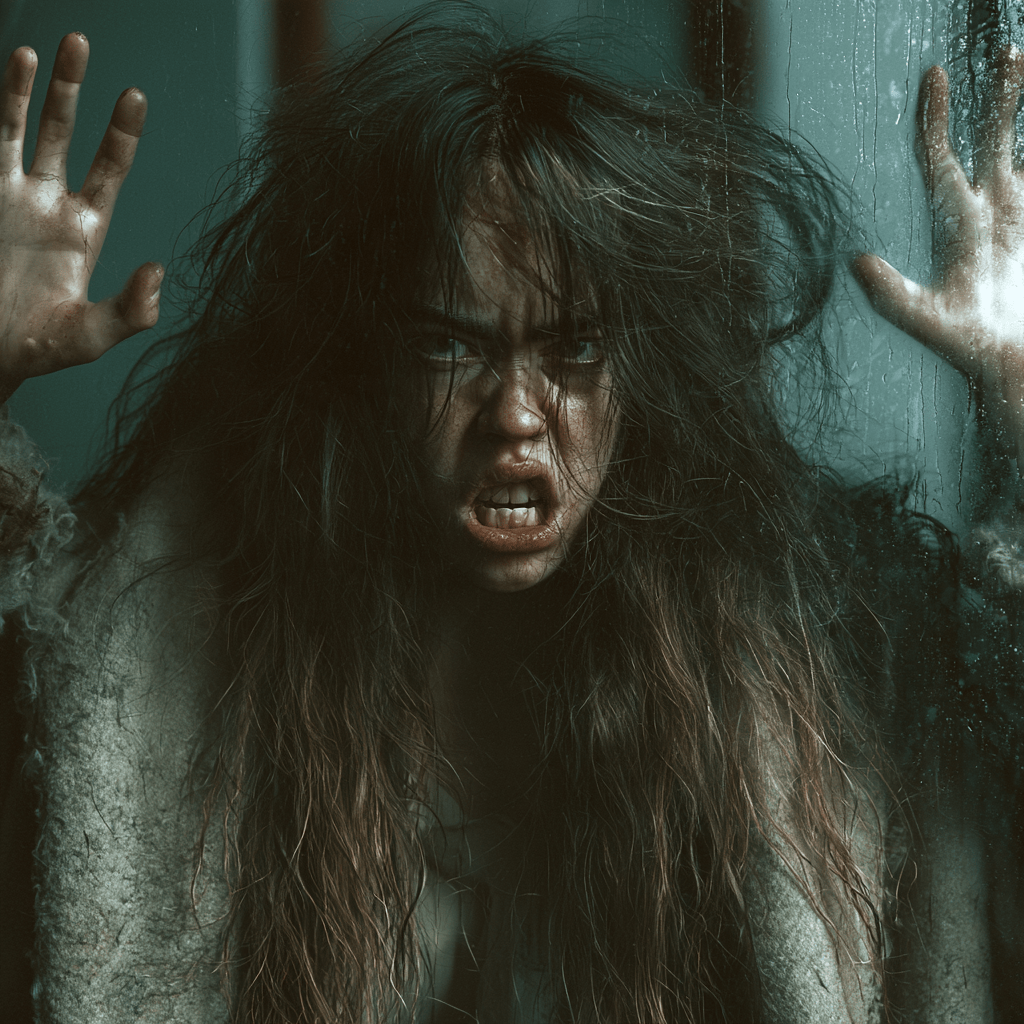
Then she saw me.
She looked straight into my eyes with an expression unlike anything I’d ever seen. Her mouth was partly open, showing her teeth. I remember her teeth almost as vividly as her eyes.
Her gaze was fierce. I couldn’t tell fear from anger or desperation.
I had never seen that look on anyone’s face, much less a child’s.
The gentleman called out again from the lobby.
“Please don’t open that door. You have no idea.”
I went back to the couch.
“What’s the deal?”
“She’s a Gypsy girl. She’ll tear this place apart.”
He told me about Romania’s Roma population in extraordinarily harsh terms. He spoke with such conviction that I found myself wondering what had happened to him to make him feel that way.
I didn’t have the cultural or historical context to understand what either of them was telling me.
What struck me most was the contrast.
On one side of that glass were chandeliers, expensive furniture, impeccably dressed hotel employees, and businessmen like me.
On the other side was a desperate young girl whose expression I couldn’t begin to understand.
I’ve never forgotten her.
Three Americans in Bucharest
I had all of Saturday free before my business meetings started, so I asked the front desk to arrange for someone to show me around the city.
A private driver with a beautiful car for the whole day: about a hundred dollars, on the room.
Sold.
Then I asked the woman at the desk a more important question.
“Where does somebody like me go to have fun tonight?”
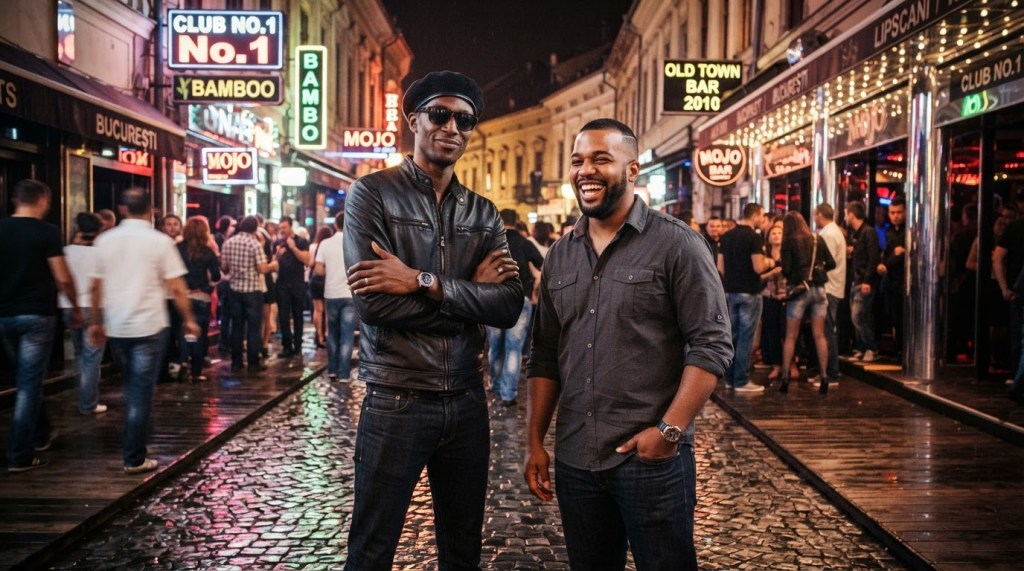
She pointed me toward Lipscani, Bucharest’s Old Town.
That still left me with no cash. The hotel wouldn’t advance me any, so I talked them into a workaround: charge the driver to my room twice, pay him the correct amount, and hand me the difference in cash. Problem solved.
When the taxi dropped me off, I thought there had been some misunderstanding.
It looked like the main street of an old Western town after a thunderstorm. Mud everywhere. Wooden walkways along the sides. No cars.
Then I noticed the clubs.
Behind those plain entrances were some of the coolest nightclubs I’d ever seen.
Chrome. Mirrors. Glass. Neon. Electronic music pouring out into the street.
Apparently, Romanians love a little flash.
The people were young, fashionable, and having a genuinely good time.
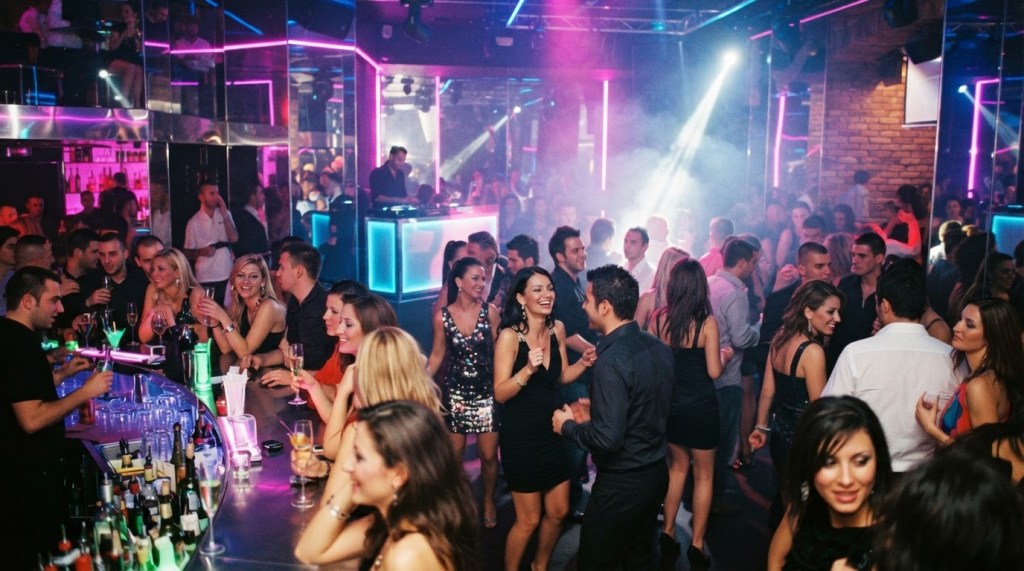
Where were these people when I landed at the airport?
I went from place to place, soaking up the atmosphere, having a drink, and doing one of my favorite things in the world: meeting people I’d never met before.
That’s when I spotted two guys.
Something about their confidence, the way they carried themselves.
I knew they were Americans.
I walked straight up to them.
“Americans?”
“Yeah. You’re American.”
“Yeah.”
“We knew.”
“I knew you were too.”
That was the entire introduction.
One was named Will. The other was Wooten.
As I recall, they were both military guys. Within an hour, the three of us were carrying on like we’d known each other for years, going from club to club, trading stories, and enjoying being three Americans who had somehow found one another in the middle of Bucharest.
There’s a particular kind of friendship that happens when you travel.
I call it an accelerated friendship.
At home, you might know somebody six months before you really connect. Put those same two people on the other side of the world, and the whole process can happen over a beer.
You may never see each other again.
But you never really forget each other either.
Will and I are still connected today. He’s a talented photographer, a serious traveler, and a foodie. We trade messages now and then and keep up with each other’s adventures.
I think of people like Will as the guest stars of my life.
They show up unexpectedly, sometimes for only a few hours, and somehow become permanent characters in your story.
I’ve been lucky enough to have guest stars all over the world.
A Saturday with Nikolai
Saturday morning was crisp and cool.
My driver was waiting outside the hotel beside an immaculate Mercedes-Benz.
His name was Nikolai.
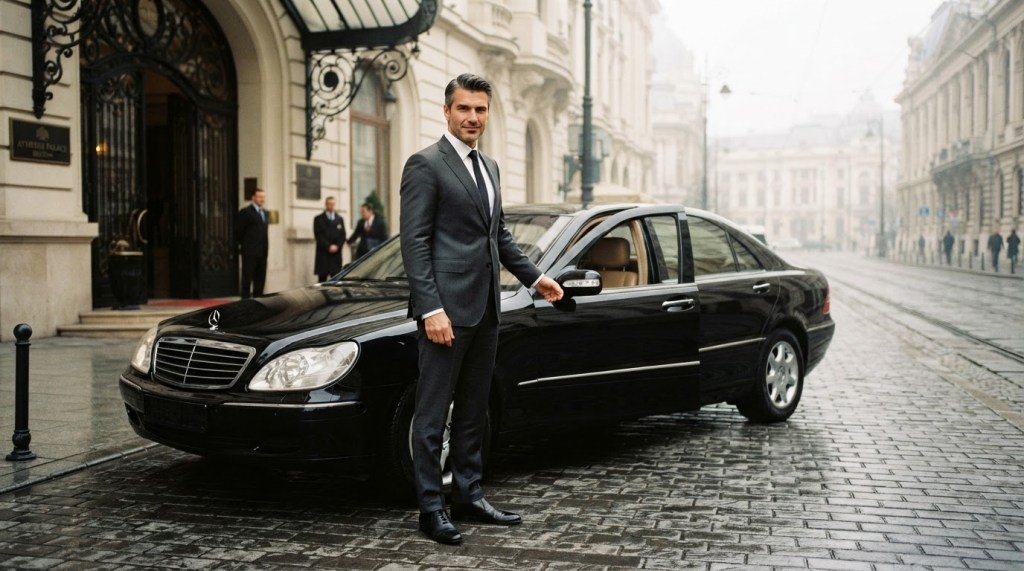
He was nothing like the man who’d picked me up at the airport. Sharply dressed, polished, professional, and pretty fluent in English.
We were about the same age.
Our first stop was for coffee. He insisted I stay in the car while he went in to get it.
When he came back, I climbed out of the back seat and joined him up front.
That simple move changed our whole day.
I didn’t want a chauffeur. I wanted somebody who could tell me about Romania.
Before long, we were two guys having coffee, talking about our lives.
We’d grown up in the same era, in two entirely different worlds.
I had grown up in America.
He had grown up under Nicolae Ceaușescu.
Until that morning, Ceaușescu had been a name from the TV news and the Cold War.
Nikolai made him real.
Ceaușescu ruled Romania from 1965 until 1989, and the more I’ve read about him since, the worse it gets. In the 1980s, he set out to pay off the country’s entire foreign debt, and his people paid for it. Gas, heat, and food were rationed. People stood in line for hours for bread and sat through winters in freezing apartments. Romania’s infant mortality rate became the highest in Europe. This was Europe, in my lifetime.
He banned abortion and contraception. More than 9,000 women died from illegal abortions, and so many children were abandoned that Romania’s orphanages overflowed.
And watching over all of it was the Securitate, his secret police. They were everywhere. Neighbors informed on neighbors. Colleagues informed on colleagues.
Nikolai told me families were terrified to talk about the government, even inside their own homes.
I didn’t get it. Surely, in the privacy of your own house, you could say whatever you wanted.
No, he said.
Children went to school.
A child might innocently repeat something his father had said at the dinner table. The teacher would make a note of the child’s name and what was said, and contact the authorities.
Then the secret police would show up at the door and take the parents away.
And they would never be seen again.
Your own home wasn’t a sanctuary. Your own children, through no fault of their own, could expose you.
I’d grown up taking freedom of expression completely for granted. I didn’t have to think about it.
Nikolai had grown up knowing words could destroy a family.
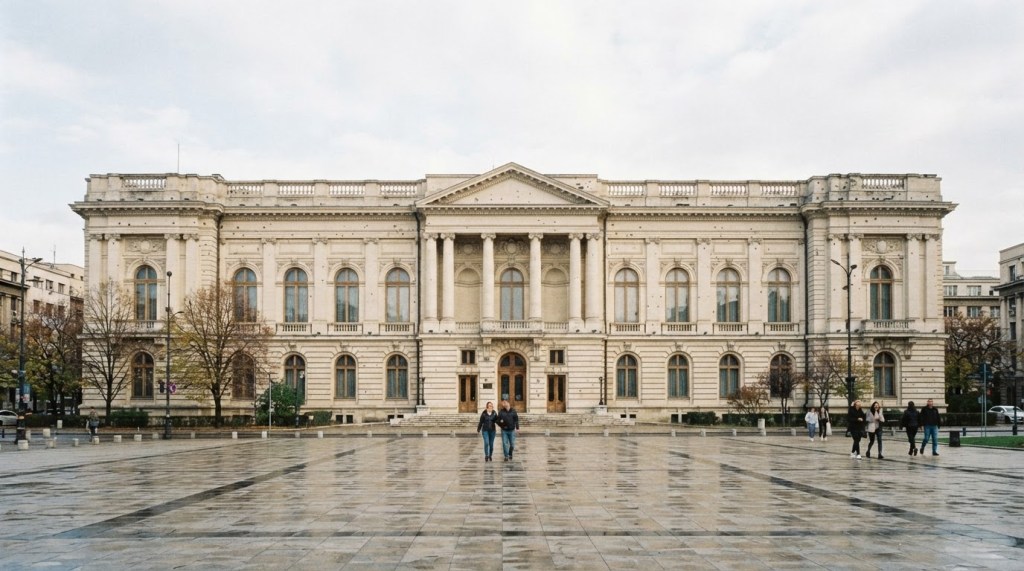
He took me to where the Romanian Revolution had unfolded in December 1989 and pointed out bullet marks still visible in the buildings.
Not photographs in a history book. Not footage on television.
Actual scars in the stone.
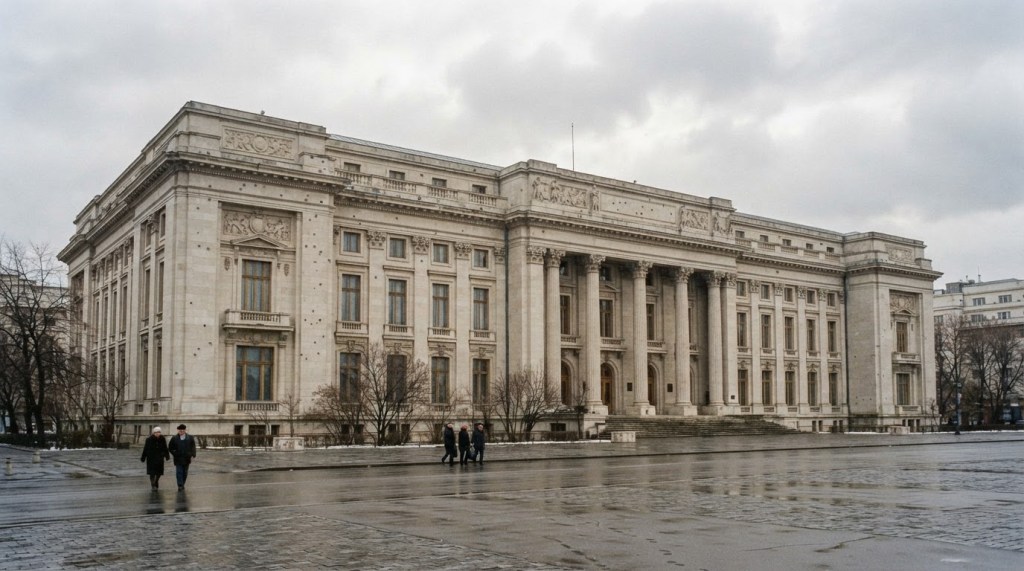
He told me how the crowd had turned on Ceaușescu, how the dictator and his wife fled by helicopter, and how they were captured.
They were executed on Christmas Day, 1989.
After nearly twenty-five years, it was over.
But as I’d discover that afternoon, ending a dictatorship and ending the fear it created are two very different things.
The village and the dogs
Nikolai took me to an open-air museum where traditional homes and buildings had been brought together from villages all over the country.
Little thatched houses, wooden churches, barns, and windmills. Some of the roofs came almost to the ground.
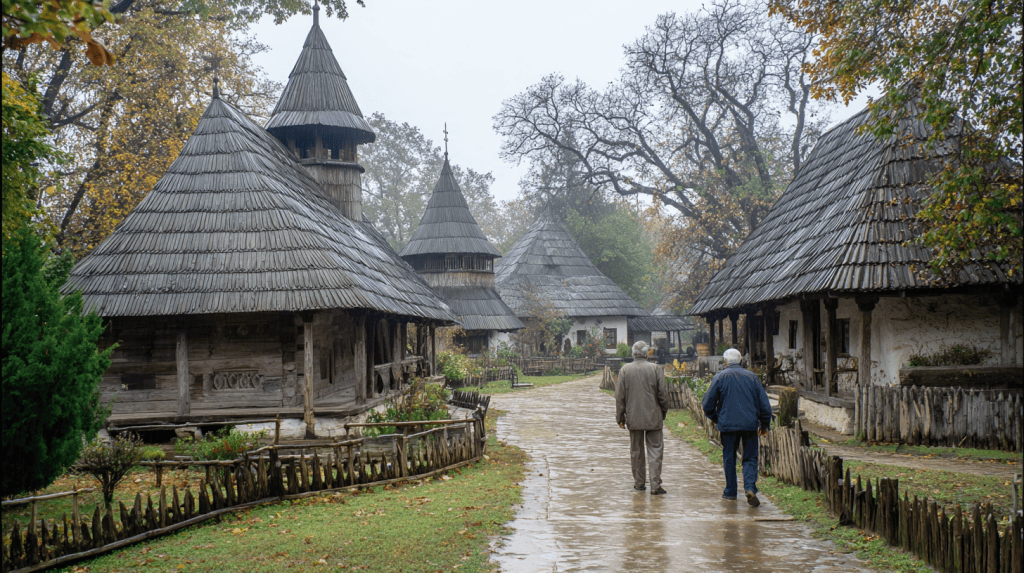
It was a reminder that Romania’s history didn’t begin with communism and certainly didn’t belong to a dictator.
Later, driving downtown, I noticed something peculiar.
Dogs.
Everywhere.
It seemed like every block had five or six strays lying around.
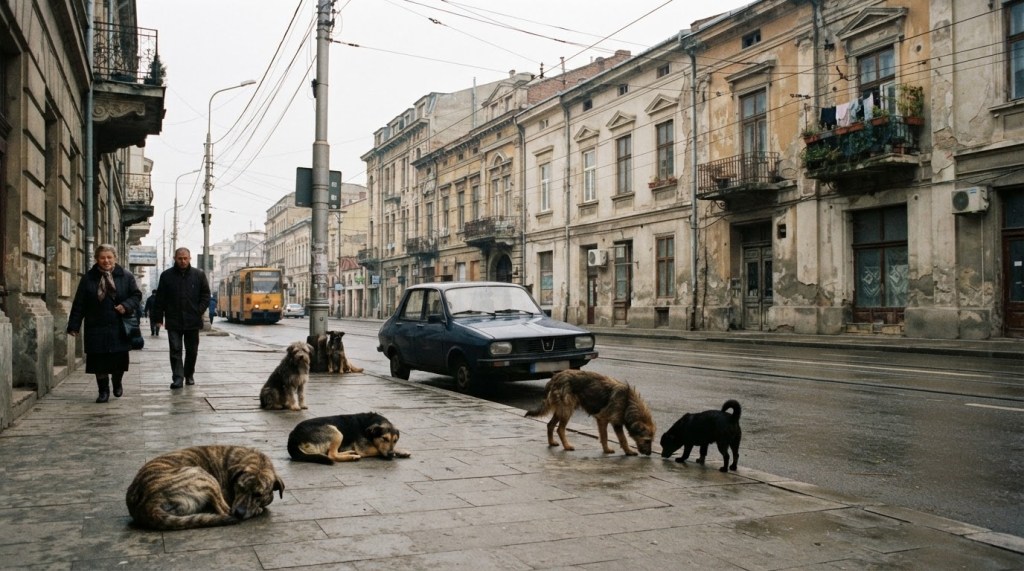
“What’s the deal with all the dogs?” I asked.
Once again, the answer led back to Ceaușescu.
Nikolai told me that when the dictator built his palace, entire neighborhoods were demolished. Families were forced out, often with little warning, and many had nowhere to take their pets.
So they turned them loose.
According to Nikolai, the dogs kept breeding over the years, and here was the result.
I’d never imagined the consequences of a political regime could show up in something as ordinary as a dog sleeping on a sidewalk.
Another piece of history the guidebooks left out.
Throughout the day, I also saw Roma families traveling in horse-drawn carts loaded with their belongings.
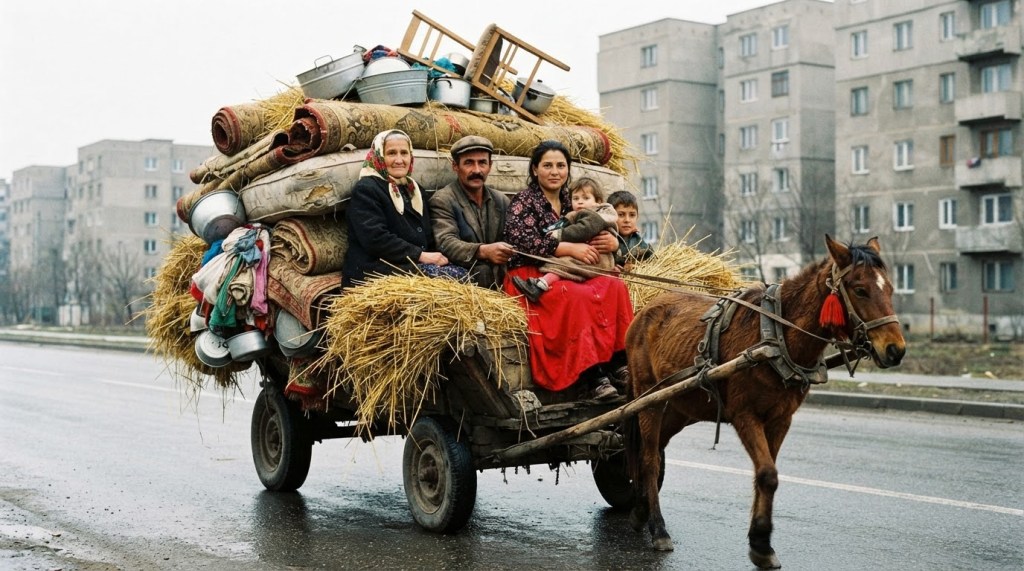
The poverty was nothing I’d expected to find in the middle of a European capital.
I was uncomfortable. Some of what I saw frightened me, and I didn’t understand why these communities seemed so cut off from the rest of Romanian society.
I’d later learn that the Roma endured centuries of enslavement in Romania, followed by generations of discrimination and exclusion.
The history was a lot more complicated than the explanation I’d gotten in the Marriott lobby.
I thought about the girl behind the glass again.
Travel had a way of doing that to me. Just when I thought I understood something, I’d discover how little I actually knew.
The palace without lights
Our final stop was the Palace of the Parliament.
Ceaușescu’s palace.
It was massive. Extravagant beyond description.
I joined a guided tour and right away noticed something bizarre.
Most of the lights were off.
All this marble, all this gold, all these magnificent chandeliers, and most of the rooms were lit almost entirely by daylight through the windows. Only a few areas had the lights on.
They were saving on electricity.
A dictator had built one of the most extravagant buildings in the world, and years later, the people running it couldn’t afford to turn on most of the lights.
At one point, we came to a huge marble staircase, one of the few places where the chandeliers were actually lit. I don’t remember how many steps there were, but I remember standing at the bottom, struck by its sheer width and grandeur.
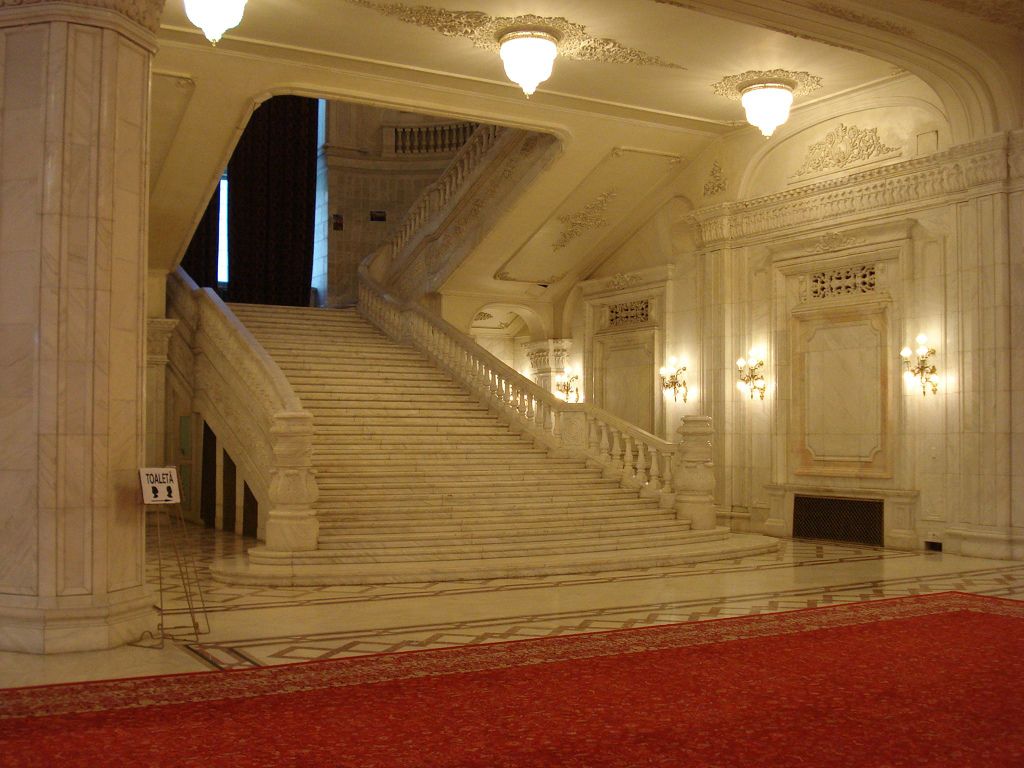
Then our guide told us something that made me wince.
As I remember the story, when the staircase was first finished, Elena Ceaușescu walked up it and stopped. The steps were off by a fraction, maybe half an inch, just enough that they didn’t feel right to her.
She was furious.
Not disappointed. Furious. Over half an inch.
And that fury rolled downhill. Her husband ordered the whole staircase torn out, and the anger cascaded through the officials, the engineers, the foremen, all the way down to the workers who had built it.
Imagine being one of those craftsmen. You’ve spent countless hours cutting, shaping, polishing, and fitting those massive pieces of marble, and the person at the very top is enraged at you over something you can barely measure. Now you’re told to destroy what you just finished.
So they built it again.
That one didn’t please her either.
Tear it out.
According to our guide, the staircase I was standing in front of was the third one.
I looked at that marble and tried to imagine what lay beneath the beauty of it. The exhausting labor. The wasted material. The people waiting for a dictator’s wife to take her first step.
And I remembered the families Nikolai had told me about that morning, forced out of their homes to make room for this place.
Half an inch.
That was the distance between her inconvenience and somebody else’s misery.
And now they couldn’t justify turning on the damn lights.
We entered a magnificent room built for foreign dignitaries. A giant round table, elaborate chairs, gold everywhere.
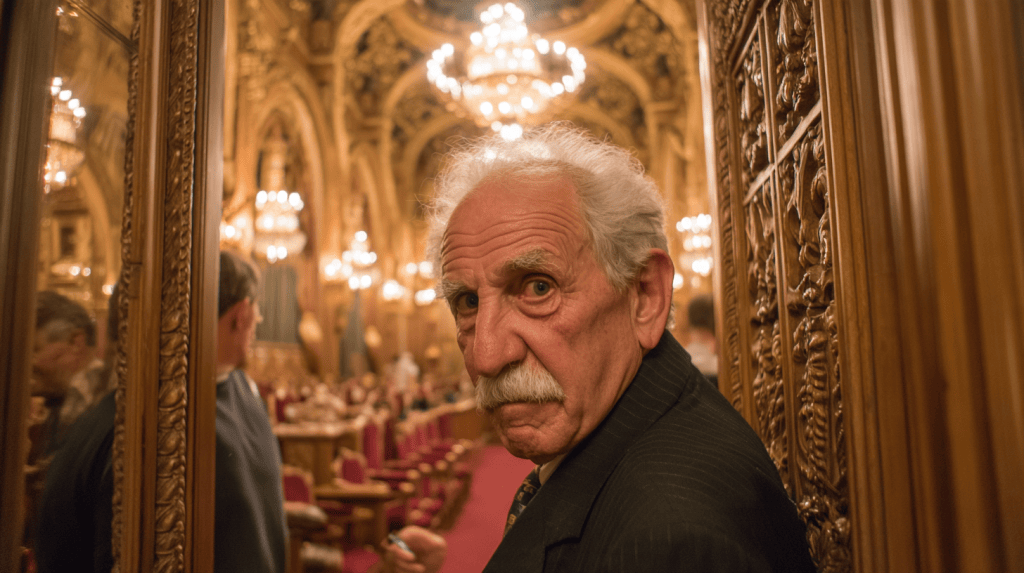
I was taking pictures when I noticed an older man with a young woman.
He kept looking at me.
Not with curiosity.
With suspicion.
He’d lean over, whisper something to her, and look back at me.
Eventually, I went over to her.
“I’m sorry. May I ask what he’s saying?”
She looked a little embarrassed.
“He’s my father. He wants you to stop taking pictures.”
“Why?”
“He thinks you’re stealing our secrets.”
I was stunned. I was an American tourist taking photographs in a room open to American tourists.
What secrets?
My first reaction was that this poor guy was just paranoid.
But later, I thought about Nikolai.
This man was maybe ten years older than me. He’d spent most of his adult life where foreigners were suspect, information was controlled, and an innocent conversation could have terrible consequences.
The dictator was gone.
The building was open.
The tourists had arrived.
But somewhere inside this man’s mind, the old Romania was still very much alive.
I thought about the man in the Marriott lobby, too. Different fears, maybe, but handed down the same way.
You can tear down a statue in an afternoon.
You can’t dismantle a lifetime of fear nearly that fast.
At the end of the day, I tipped Nikolai generously, swapped contact information, and thanked him.
I’d hired a tour guide.
I’d made a friend.
Another guest star.
A bomb waiting for an ignition source
On Monday, it was time to get back to the reason I’d come.
I met Andrei, our Romanian country manager. Our job was to bring some very advanced industrial technology into the Romanian market and figure out whether there was a real business here.
That week, we visited a refinery in Ploiești, north of Bucharest.
I’ve been inside a lot of refineries.
I had never experienced anything like this one.
The smell of gasoline and hydrocarbons was overwhelming.
It was everywhere. It seemed like somebody had spilled a tanker’s worth of gasoline and simply gone about their business.
I thought to myself, this place is a bomb waiting for an ignition source.
I was literally looking around to see if anybody was smoking.
If I’d seen somebody light a cigarette, I would have run.
At one point, Andrei turned to me.
“How many pieces of equipment do you think we could put our systems on?”
I looked at him.
“You know what? Forget about it. We’re not selling anything here.”
He looked puzzled.
Our technology solved highly specialized safety problems. It was the kind of investment you made after you had the basics of industrial safety nailed down.
This place had much more fundamental problems. If management truly cared about safety, they had a mountain of work to do before they’d ever need to talk to somebody like me.
Andrei looked around.
“Yeah,” he said. “I guess you’re right.”
As we walked, I noticed a huge warehouse a little way off from the process units.
Half of it was caved in.
Not falling apart. Crushed. Like somebody had started demolishing it and walked away halfway through.
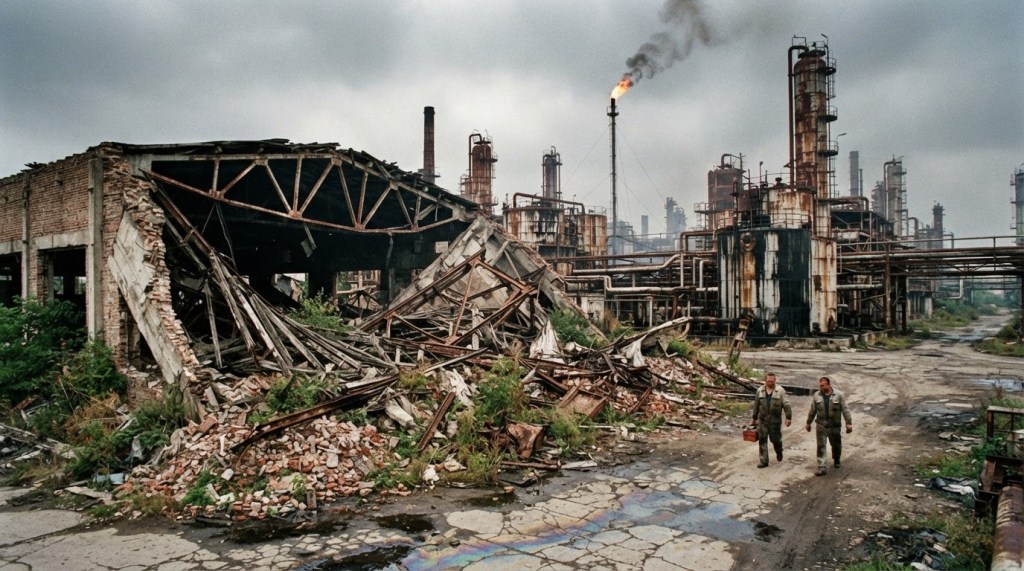
I asked our hosts what had happened.
“World War II,” one of them said. “Bombing.”
He said it the way you’d mention the weather.
Half a building, still lying there in pieces all those decades later. Nobody had cleared it. Nobody had fixed it. It was just part of the scenery.
Somehow, that told me everything I needed to know about this place.
At least nobody had called the refinery a national treasure.
Small world
On the days Andrei was off doing his own thing, I worked out of his office with his people, learning how they operated, helping them understand what we were bringing, and building a strategy together.
Two of them became my champions that week: Ciprian, Andrei’s right-hand man, and Dr. Sorin Dinu. They took me to site after site, and in between, the three of us sat in that office and sketched out the plan.
One of those afternoons, I headed back to the Marriott.
Walking through the lobby, I glanced toward one of the seating areas.
There was Andrei.
And sitting across from him was Will.
Portfolio shots and photographs were spread across the coffee table between them. They were talking photography.
I stopped.
What the hell?
I was thousands of miles from home, and two of the handful of people I knew in the entire country were sitting together, completely independently of me.
One was my business colleague.
The other was a guy I’d met in a nightclub.
They looked up.
“Hey, buddy!”
I couldn’t stop laughing.
The world does that occasionally. It reminds you it’s nowhere near as big as you’ve convinced yourself it is.
And Romania wasn’t finished with me.
There was a guy in my company named Claudio. Over the years, I’d run into him all over the world. Moscow. Singapore. Kuala Lumpur. Vienna. Never once in either of our home countries. Only in places where neither of us lived. It always started the same way: my name yelled across a hotel lobby in that German accent. Brilliant guy. Nobody else on earth says my name like that.
This time, he didn’t yell.
One night, my phone buzzed.
“Hey man, where are you?”
“I’m in Romania.”
“Get out. Me too.”
“No way.”
“Yeah. I’m staying at the Marriott.”
“Me too.”
He was two floors directly above me.
We’d been texting each other across a ceiling.
What Romania taught me
I’d come to Romania with a simple business objective: find out whether the market was viable.
My first impressions weren’t encouraging. The airport. The money problem. The gray streets. The poverty. That refinery.
If I’d judged it on my first twenty-four hours, I’d have said there was nothing there.
I would have been spectacularly wrong.
It started with Ciprian.
After that first week, he wanted to come work alongside our engineers, so I sponsored an extended trip for him to Houston to learn everything he could. When he flew home to Bucharest, the business took off. After that, it was on fire. He came back three or four more times and became one of our best partners.
Romania became one of the biggest markets I ever opened.
And it wasn’t because of me.
The people in that office were some of the most gracious I’ve ever met. Professional, well educated, extremely bright, and even friendlier than they were bright. I couldn’t have asked for a better team.
They took our technology and treated it like it was their own. They were ambitious, entrepreneurial, and proud of what they could do.
They wanted somebody to believe in them.
They wanted the chance to prove they could build something significant.
And they did.
Today, Ciprian has his own company. He took the business we planted on that trip and ran with it, and now he employs somewhere between 50 and 100 people.
He’s still one of my friends. Another gem.
Over my career, I came to realize that opening an international market wasn’t really about bringing a product into a country.
It was about finding the right people, believing in them, and giving them a reason to believe in you.
I could have stayed in Vienna that weekend, flown in Sunday night, held my meetings, and left.
I would have missed everything.
The driver who was so proud of his arch.
Will and Wooten.
Nikolai and his stories.
Ciprian and Sorin.
Claudio, two floors up.
The old man in the palace.
The girl behind the glass.
I would have known something about doing business in Romania.
But I wouldn’t have known much about Romania.
I still think about that first driver, pointing out everything he loved about his country.
At the time, I thought he was a little naive.
Looking back, maybe he understood something I hadn’t figured out yet.
Romania’s greatest national treasures weren’t its monuments, its palaces, or its architecture.
They were its people.
Bucharest was gray the night I arrived.
It wasn’t gray at all.
I just hadn’t met anybody yet.

